The machine learning fog
Everyone is trying to implement - somehow - Machine Learning/Deep Learning (ML/DL) models into their businesses or work. And they should. The promise is clear: increased productivity, time savings, competitive advantage. But there’s a disconnect between the hype and the reality of what it actually takes to make machine learning work in the real world. There is a fog around machine learning and its meaning in general.
At the same time, we have 3-5 generations of engineers who graduated before machine learning became a critical skill in the industry. They’re now trying to upskill themselves - somehow - by adding ML/DL capabilities to their CV. Some take weekend courses. Others dive into Kaggle competitions. Many are left wondering if they’re learning the right things, or if they’re just collecting certificates that won’t translate to actual job competitiveness.
The landscape doesn’t make it any easier. We all know it’s almost impossible to keep track of all the new AI/ML breakthroughs that seem to emerge every two weeks. These are genuinely amazing advances, but they also add tremendous noise to the concept of “Machine Learning” itself. Each new model, framework, or technique makes it harder to distinguish between what’s fundamental knowledge and what’s just the flavor of the month. This confusion makes it increasingly difficult to understand what tools and skills you actually need when it comes to implementing ML solutions that make a real impact in daily operations.
This creates real problems on both sides of the equation.
One the one hand, if clients knew what to expect - and what it truly takes to implement a ML solution -they would make much smarter investment decisions. Right now, many can’t tell the difference between products. Am I being sold an elegant AI-wrapper around OpenAI/Anthropic/Gemini for hundreds of dollars in monthly subscriptions (with often unclear pricing that scales with usage)? Or am I getting actual software that will belong to me? Pay once for the implementation service, no recurring costs, and benefit from it for years to come?
These are fundamentally different value propositions, but they’re often marketed with the same buzzwords.
And on the other hand, if engineers knew what to expect from the career path of machine learning engineering - and what they are actually getting themselves into - they would make better and more informed career decisions.
What should I realistically expect if I want to add these skills to my portfolio? Will it be enough to learn how to fit a neural network to my data? Or is that an overkill for most real-world problems? Once I complete a bootcamp or online course, will I actually be competitive in the job market, or do I need to become a full-stack software engineer first?
The latter option would mean committing to what’s essentially a second degree. So we went from attending one AI workshop to signing up for years of additional education… at which point you have to ask:
Should I have just focused on deepening my current expertise and found other ways to enhance my CV instead?
So what the hell is actually Machine Learning?
Imagine you’re building a car. Who would you hire? You need a mechanical engineer to design it (CAD, combustion engine, hydraulics, heat management, and a long etc.). You’ll need an electrical engineer (circuits, battery, control systems). You’d also need a software engineer for the user experience of the infotainment system. And we’ve just scratched the surface. Would you expect one engineer to have all of those skills? Would it also be enough to just have the combustion engine attached to the wheels?
The answers are obviously no.
Here’s the thing: the expectations for Machine Learning Engineers have somehow become similar to answering “yes” to those questions. Let me show you what I mean with a real-world example.
The extent of machine learning engineering with a real-world project
Say you’re a mining company that wants to detect defects on your conveyor belts before they cause costly downtime. Sounds straightforward, right? Just train an AI model to spot the defects. Except that’s like saying “just attach the engine to the wheels” when building a car.

A complete ML project involves several distinct engineering disciplines
Data Engineering: First, you need to capture high-quality images from cameras mounted along the conveyor system, sync them with sensor data (vibration, temperature, load), store terabytes of footage, and build pipelines that clean and label this data. This is a full engineering discipline on its own. You’re building infrastructure that runs 24/7 in harsh industrial environments.
Model Development: Now comes the “AI part” everyone thinks of: training a computer vision model (likely a CNN) to detect cracks, tears, misalignments, and material buildup. You’ll experiment with different architectures, handle class imbalance (defects are rare), and ensure the model works under varying lighting conditions and material types.
MLOps Engineering: Your model works great in testing, but now you need to deploy it to run in real-time, version it properly, monitor its performance as conditions change, retrain it when needed, and ensure it doesn’t degrade over time. You’re building a system that needs to be as reliable as any other critical mine infrastructure.
Software & Cloud Engineering: Finally, you need to build an actual application that mine operators can use. Real-time alerts when defects are detected, a dashboard showing conveyor health, integration with existing maintenance systems, and all of this potentially running on-premises because many industrial sites have limited connectivity.
So is it fair to expect all of this from one single ML engineer? Well, more or less. If you look for senior machine learning engineers (or you want to be one yourself), it’s reasonable to expect them to know 80% of all the things we mentioned above, but be prepared to offer compensation that matches those expectations (like hiring a mechanical engineer with extensive software engineering skills).
What is definitely not okay is to look for junior ML engineers, expect them to do all of that, and offer an entry-level salary. It’s one or the other.
ML engineers using coding assistants
It’s also fine to expect “more” skills from a ML engineer than when compared to “classical” engineers (like in our car example). Since the democratization of coding assistants, and them getting better and better, experienced machine learning engineers can actually code in many different languages to deliver a full ML project on their own.
From Python to C++ or Rust, all the way down to TypeScript, React/React Native, and Node.js (as well as the deployment/monitoring tools like Kubernetes, Bash, etc.). These are, at the end of the day, the tools that ML engineers use in real-world projects, and with the help of (responsibly!) using coding assistants, you can deliver actually be that engineer that takes care of an entire ML project with the help of coding assistants.
The real added value a ML engineer brings is knowledge: the ability to clearly see all the implementation steps, from conception to deployment, of a ML project. And this knowledge comes from real-world projects that people actually use, often in underserved industries where off-the-shelf solutions don’t exist. This teaches that knowledge at a meta-level of what to do and not to do (tools, project outline, etc.) when working on an ML project.
What am I asking for?
So whether you’re a recruiter, a team lead, or an engineer who wants to implement - somehow - machine learning into their project/business case/team/CV, you should always start here: What am I asking for?
If you’re a client or team lead:
Experience required: Do I need/want a junior or senior ML engineer for this task?
Budget & Time: Do I need just a model to show results in a meeting, or a full end-to-end project with software integration included that would likely take 6 months?
How many people?: Would I expect one engineer to build an entire car, or do I need to look for an entire team?
If you’re an engineer looking to break into ML:
Skills you have: Am I coming from data science, software engineering, or starting fresh?
Investment I can make: Do I need a full career pivot (bootcamp/degree), or can I upskill within my current role?
Realistic expectations: Am I ready to be (maybe again) a junior on a team, or do I need to build full-stack capabilities to work independently?
So what the hell is machine learning engineering?
Machine Learning Engineering isn’t just training a model: it’s the complete end-to-end implementation spanning data engineering, model development, MLOps, and software integration to create solutions people can actually use. The real value is having the knowledge to see and execute all implementation steps from conception to deployment, turning AI from a demo into production-ready software.
If you want to know what is the extent of a real-world AI/ML project for your particular use case, take a look at our website and book a free consultation with us to get started.
Book of the Week
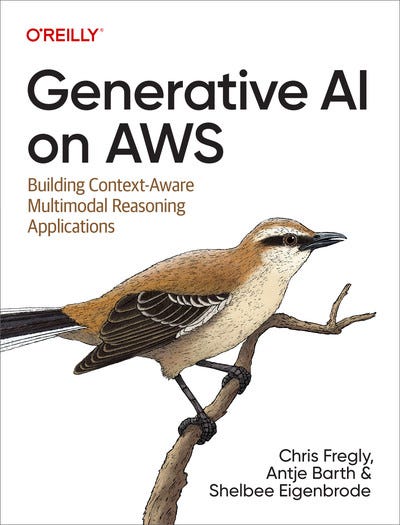
Talking about real-world AI implementation, Generative AI on AWS by Antje Barth and Shelbee Eigenbrode is a great place to start.